When do you need an apostille?
The Golden Seal: Navigating Apostilles Between the USA, Mexico, and Vietnam
In the world of international law and cross-border business, a document signed in one country is, by default, legally invisible in another. A Power of Attorney notarized in Texas has no inherent legal weight in Mexico City; a birth certificate from Ho Chi Minh City is just a piece of paper to a court in New York. To bridge this gap, international treaties created a verification system known as the Apostille.
For decades, the legal relationship between the United States, Mexico, and Vietnam required different protocols. However, with Vietnam’s recent accession to the Hague Apostille Convention (effective 2024), the landscape has shifted. This article outlines exactly when and why you need an Apostille across these three jurisdictions, covering corporate, civil, and administrative law.
What is an Apostille?
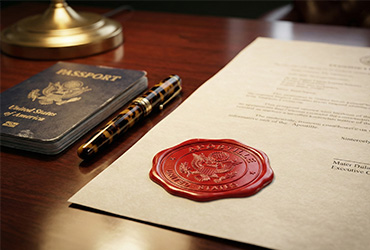
An Apostille is a specialized certificate issued by a "Competent Authority" (usually a Secretary of State or Ministry of Foreign Affairs) that authenticates the origin of a public document. It does not validate the content of the document, but rather verifies the authenticity of the signature and the capacity in which the person signing the document acted. It is essentially a "passport for your documents," allowing them to travel between member countries of the Hague Convention without further diplomatic legalization.
Scenario 1: Corporate and Commercial Law
The most frequent use of Apostilles occurs in business expansion. When a company moves from the US to Mexico or Vietnam (or vice versa), the legal entity must "prove" its existence to foreign authorities.
Establishing Subsidiaries and Branches
If a US corporation wishes to incorporate a subsidiary in Mexico (an S.A. de C.V.) or obtain an Investment Registration Certificate in Vietnam, local authorities will demand the parent company's Articles of Incorporation and Certificate of Good Standing. These documents must be apostilled by the Secretary of State where the US company is incorporated before they are accepted by the Mexican Public Registry of Commerce or the Vietnamese Department of Planning and Investment.
International Powers of Attorney (POA)
This is the single most critical document in cross-border law. A US CEO cannot always fly to Mexico or Vietnam to sign contracts. Instead, they grant a Power of Attorney to a local lawyer or manager. For this POA to be valid:
- USA to Mexico: The POA is signed before a US notary, then apostilled by the state. In Mexico, it must then be translated by an official expert translator (perito traductor) and protocolized by a Mexican Notary.
- USA to Vietnam: The POA follows a similar path. While Vietnam historically required "Consular Legalization" (a longer, three-step process), the new Hague status allows for a direct Apostille, though practical implementation in some Vietnamese provinces is still transitioning.
Scenario 2: Civil Law and Family Matters
Individuals crossing borders for marriage, inheritance, or dual citizenship face strict documentary requirements. Civil registrars are bureaucratic and inflexible; an un-apostilled document will result in an immediate rejection.
Dual Citizenship and Vital Records
For a child born in the US to obtain Mexican or Vietnamese citizenship (and the corresponding passport), the foreign government must see a US Birth Certificate. This document must carry an Apostille from the state where the child was born. Without it, the foreign registry cannot create a local birth record.
Marriage and Divorce
If a US citizen wishes to marry a local national in Vietnam or Mexico, they must provide proof of "single status" (an affidavit stating they are free to marry) and usually a divorce decree if previously married. These court documents require Apostilles. Conversely, a divorce finalized in a Mexican court must be apostilled to be recognized in US proceedings, particularly regarding alimony or division of assets.
Inheritance and Probate
When a person dies leaving assets in multiple countries, the Death Certificate and the Last Will and Testament must be authenticated. If a Mexican national dies in California, their death certificate needs a California Apostille to close bank accounts or transfer real estate titles located in Mexico.
Scenario 3: Employment and Immigration
The movement of talent between these nations triggers a need for educational and background verification. This is particularly relevant for the "nearshoring" boom in Mexico and the manufacturing rise in Vietnam.
Work Permits and Expert Visas
To obtain a work permit in Vietnam (or a permanent residency visa in Mexico), foreign professionals must often prove their qualifications. Authorities will require University Diplomas and Transcripts to be apostilled. In the US, this is a multi-step process: the university registrar notarizes the diploma, and the state Secretary of State then apostilles that notary's signature.
Background Checks
Both Mexico and Vietnam often require a criminal background check (such as an FBI Identity History Summary) for long-term residency visas. Because the FBI is a federal agency, this document cannot be apostilled by a state. It must be processed by the US Department of State in Washington, D.C. Attempting to use a state-level Apostille for a federal document is a common and costly error.
Navigating the Nuances: Mexico vs. Vietnam
While both countries are now Hague members, the practical experience differs:
The Mexico Route
Mexico has been a party to the Hague Convention for decades. The process is streamlined and well-understood by virtually every Mexican Notary and government official. The challenge usually lies in the translation; Mexico requires translations to be done after the Apostille is attached, by a certified translator within Mexico.
The Vietnam Route
Vietnam represents a "New Era." Previously, documents had to go to the Secretary of State, then the US Department of State, and finally the Vietnam Embassy (Consular Legalization). As of 2024, Vietnam accepts Apostilles. However, old habits die hard. Some local provincial officials may still ask for consular stamps out of habit. It is vital to carry a copy of the official circular confirming Vietnam’s accession to the Hague Convention when presenting documents in rural or less internationalized provinces.
Strategic Summary
Whether you are litigating a contract dispute in Guadalajara, setting up a factory in Hai Phong, or claiming inheritance in Texas, the Apostille is the bridge that connects these legal systems. The golden rule of cross-border documentation is simple: Notarization verifies the person; Apostille verifies the notary. Without this chain of trust, your legal strategy stops at the border.
Category:
Recent Post